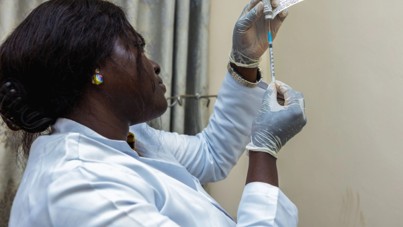
Photo: A research pharmacist prepares a vaccine for the Lassa fever clinical trial in Ghana. (Kintampo Health Research Centre / CEPI)
Nigeria Health Watch (allAfrica) | 10.21. 2026
● Summary
- The first participants have received doses of 'ChAdOx1 LassaJ', a Lassa fever vaccine candidate designed by Professor Sarah Gilbert, at the Kintampo Health Research Centre in Ghana.
- Supported by the Coalition for Epidemic Preparedness Innovations (CEPI), the trial will assess the vaccine's safety and immune response in up to 51 healthy adults aged 18–55.
- More than 50 years after Lassa fever was first identified, there is still no licensed vaccine. The trial is therefore considered an important step forward for public health in West Africa.
A clinical trial of 'ChAdOx1 LassaJ', a Lassa fever vaccine candidate developed by the University of Oxford, has begun in Ghana, with the first participants receiving vaccinations at the Kintampo Health Research Centre in central Ghana.
The trial will evaluate the vaccine's safety and immune response in up to 51 healthy adults aged 18–55, following the same approach as an ongoing clinical trial in the United Kingdom. The Coalition for Epidemic Preparedness Innovations (CEPI) is funding both trials.
Lassa fever is a viral disease first identified in northeastern Nigeria in 1969. It is primarily transmitted through food or household items contaminated by infected rodents (Mastomys rats). Severe cases can cause extensive bleeding and may be fatal. Hundreds of thousands of people are infected across West Africa each year.
Kwaku Poku Asante, Director of the Kintampo Health Research Centre, explained that although Ghana is not currently experiencing an outbreak, the research is important because Lassa fever is common in Nigeria and cross-border travel is frequent. Katrin Ramsauer, CEPI's Lassa fever Programme Lead, highlighted the fact that no vaccine has been licensed more than 50 years after the disease was discovered. She added that the trial would also help strengthen research capacity in West Africa.
According to CEPI's modelling, if a safe and effective vaccine were rolled out across West Africa, it could save approximately 3,300 lives and reduce societal costs by up to $128 million over ten years.
The vaccine candidate was designed by Professor Sarah Gilbert of the University of Oxford's Pandemic Sciences Institute. It uses the same vaccine platform as the Oxford–AstraZeneca COVID-19 vaccine, which is estimated to have saved more than six million lives in 2021 alone.
The Lassa Fever Coalition, led by the West African Health Organisation (WAHO), is coordinating regional preparations to ensure equitable vaccine introduction. Virgil Lokossou, WAHO's Director of Health Services, described the trial, led by West African scientists, as a source of regional pride.
CEPI has committed up to $24.9 million to support the University of Oxford's Lassa fever vaccine research.
※Dame Sarah Catherine Gilbert is the laureate of the 5rd Sunhak Peace Prize.
If you would like to learn more about her achievements in promoting peace, please click the link below for detailed information.
→ https://sunhakpeaceprize.org/en/laureates/laureates_view.php?idx=571