
―
The Eco-Friendly Lie
Greenwashing
―
"Greenwashing"
A term combining "green" and "whitewashing," used when something is made to appear more environmentally responsible than it really is.

▲ Environmental language can create a green image even when the underlying evidence is weak or incomplete.Source: World Economic Forum
Phytoncide air freshener, organic toothpaste, All-Natural shampoo.
These "eco-friendly" products are commonly found around us. But if you look closely, there is often no explanation of how much natural ingredient is actually used — or only a small percentage of it is included. This is so-called greenwashing that deceives consumers.
The more climate change and eco-friendliness are emphasized, the more often we hear the word "greenwashing." What exactly does greenwashing mean?
Greenwashing means presenting a product, service, organization, or policy as more environmentally responsible than it really is. It is "whitewashing," which means applying a layer of paint to cover an essential problem — a compound word combining "whitewashing" (the phenomenon of hiding crimes or unpleasant facts) with "green," meaning the environment. It refers to the act of promoting an eco-friendly image by exaggerating or falsely advertising a product or service as eco-friendly, when it is not, in order to gain economic benefit. Put simply, it means looking greener than the evidence supports.
It is known that the term greenwashing was first used in an essay on a trip to Fiji by American environmentalist Jay Westerveld in 1986.
At the time, the Fiji resort he visited was urging guests to reuse towels to help protect the sea and coral reefs. However, the resort was building new bungalows that were far from environmentally friendly, and he realized that the towel-reuse policy wasn't meant to protect the environment at all, but to cut laundry costs — so he coined the term "greenwashing."
―
Consumer Environmental Awareness ↑
Corporate Greenwashing ↑
―

▲ As public concern about sustainability grows, companies face stronger incentives to present themselves as environmentally responsible.Source: Sunhak Peace Prize
Why do companies greenwash? The simplest answer is that they want to look responsible in the eyes of consumers, investors, regulators, and business partners. They want to create an image of a company that cares about the environment, improve relationships with regulators, partners, and government, and win consumer trust. Consumer trust, after all, is linked to greater financial profit.
As eco-friendliness and sustainability become important issues worldwide, consumer awareness of the environment keeps rising. As ESG* management has become mainstream globally and consumer interest in the environment has grown, "eco-friendly" has become an issue crucial to a company's very survival.
* ESG = "Environmental, Social, and Governance"
▲ Korea: One-Third of Consumers Consider a Company's Eco-Friendly Activities When Purchasing
According to the "KB Trend Report: ESG and Eco-Friendly Consumption Behavior" published by KB Financial Group (Sept. 2021), one-third of Korean consumers consider a company's eco-friendly activities when purchasing products. They also said they'd be willing to buy eco-friendly products even at a 10% price premium.
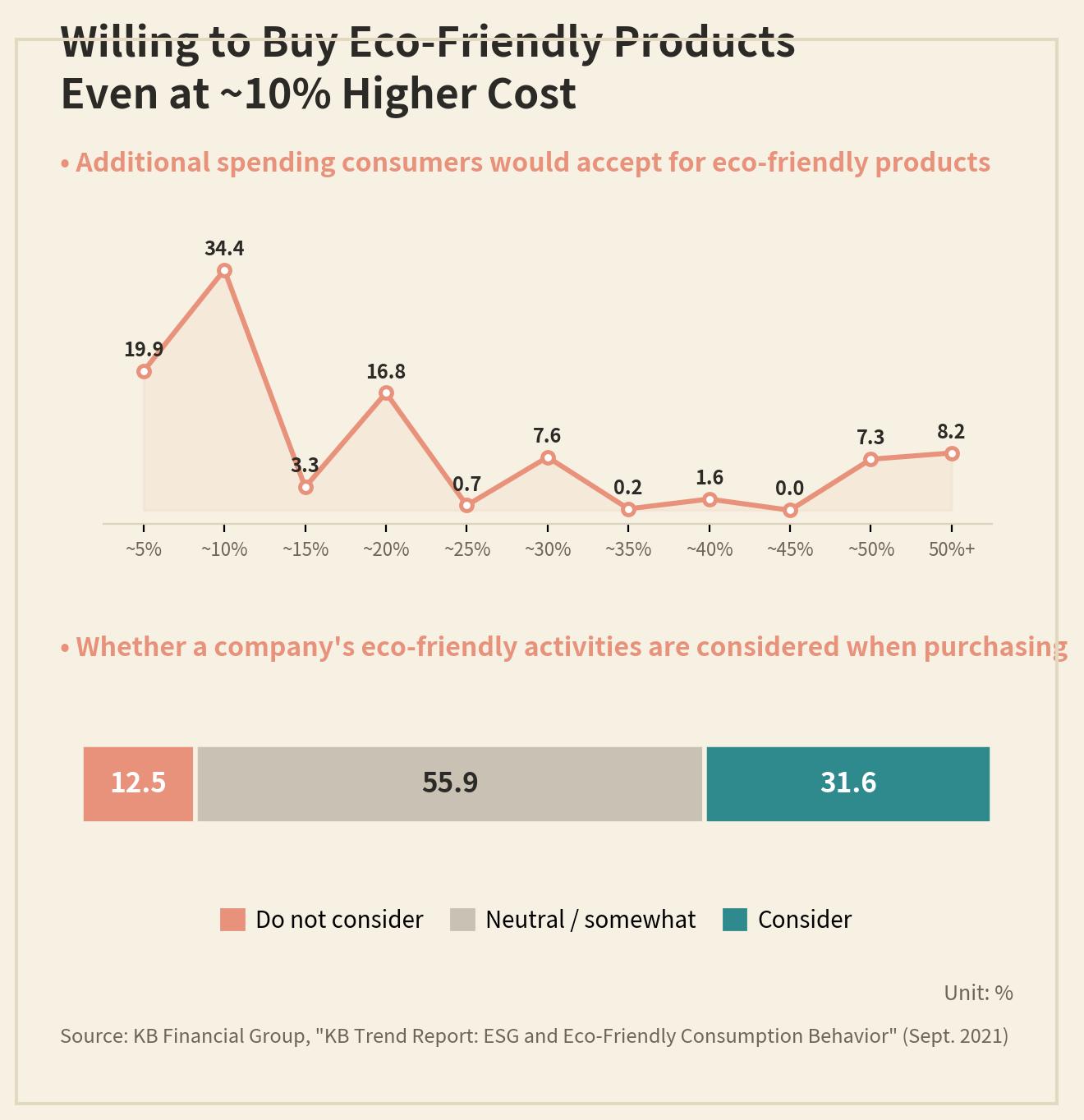
▲ Consumer surveys show that environmental performance increasingly influences purchasing decisions.Source: KB Financial Group; Forbes
▲ UK: 31% of Online Shoppers Prefer "Green" Brands
According to a 2021 Forbes report, 31% of UK online shoppers prefer brands perceived as "green," and 37% try to order from within the UK to reduce their carbon footprint.
This isn't just a UK trend. According to PwC's 2024 global consumer survey (over 20,000 respondents across 31 countries), 80% of consumers worldwide say they're willing to pay an average 9.7% premium for sustainably produced goods — confirming that this preference extends well beyond the UK.
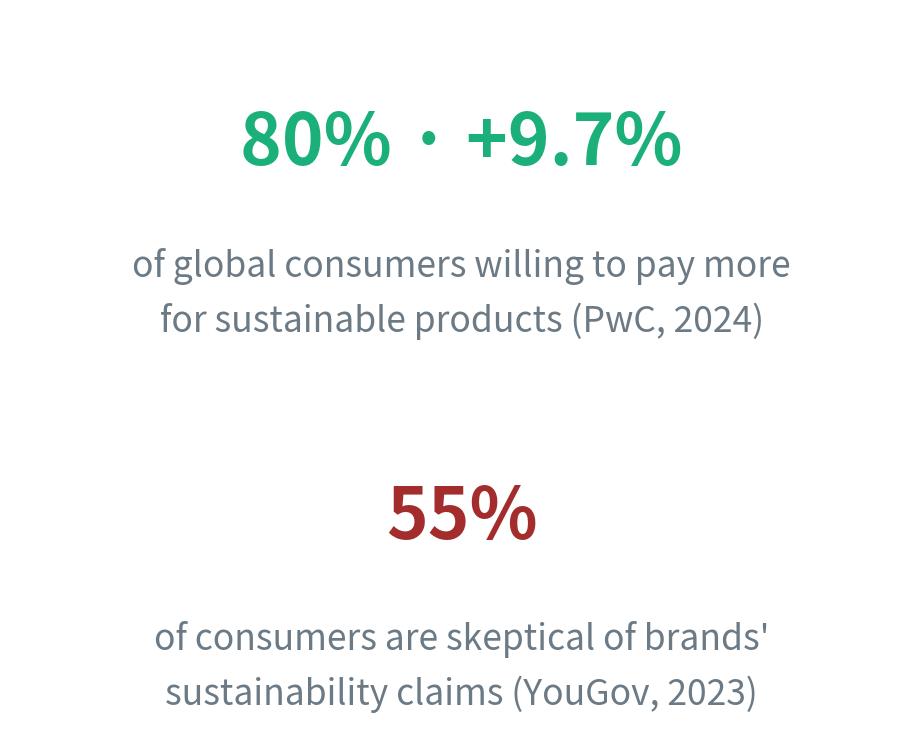
▲ Most consumers in a global survey said they were willing to pay more for sustainably produced goods.Source: PwC, Voice of the Consumer Survey 2024
―
Cases Where the Only "Eco-Friendly" Thing
Is the Greenwashing
―

▲ Greenwashing often relies on packaging, labels, or slogans that imply a broader environmental benefit than the evidence supports.Source: Sunhak Peace Prize
▲ Company: A "Paper Bottle" Actually Made From Plastic
In April 2021, BBC reported on the controversy over the "Paper Bottle" marketed by a well-known Korean cosmetics company. The product was wrapped inside with recyclable plastic, with a paper label on the outside, and marketed as using 51.8% less plastic than the company's existing products, complete with recycling instructions.
However, the bold text "HELLO, I'M PAPER BOTTLE" printed on the wrapper led consumers to assume the entire container was made of paper, sparking a greenwashing controversy and a boycott.
The company responded, "We apologize for the confusion and for not delivering more accurate information."

▲ A "paper bottle" controversy showed how a prominent claim can lead consumers to misunderstand what a package is actually made from.Source: Facebook; BBC Korea
▲ Country: Saudi Arabia and Its 50 Billion Trees?
Greenwashing criticism isn't limited to companies — nations face it too. In 2021, Saudi Arabia announced a plan to plant 10 billion trees within the country, while the wider Middle East Green Initiative proposed planting 50 billion trees across the region.
Critics noted that such a vast planting program in a water-scarce region would need clear plans for species selection, water supply, land use, and long-term maintenance. Critics pointed out that "planting tens of billions of trees in a country with no rivers is nothing short of a greenwashing joke."
▲ NGO: An Environmental Group Backed by Plastic Companies
Singapore-based non-profit the Alliance to End Plastic Waste (AEPW) reportedly spent $1.5 billion on plastic waste cleanup.
However, a Reuters investigation in January 2021 revealed that the group itself had greenwashed. It is backed by oil companies including Royal Dutch Shell and ExxonMobil — companies that, it turns out, plan to dramatically increase their plastic production.
―
7 Smart Ways to Spot Greenwashing
―
So how can we spot greenwashing?
The most commonly cited standard is the seven criteria established in 2010 by TerraChoice, a Canadian environmental marketing firm.
TerraChoice sent greenwashing survey teams to major retailers in the UK, US, Canada, and Australia in both 2007 and 2009, examining the environmental claims of 10,419 products across 4,705 product categories. Most companies were found unable to provide evidence to support their eco-friendly claims — instead relying on vague language and inappropriate certification labels to obscure their non-environmental impact.
As a result, 98% of products in 2007 and 95% in 2009 were found to contain at least one instance of greenwashing. The joke that companies are "selling the environment" to deceive consumers isn't far off the mark.
Let's take a closer look at the "Seven Sins of Greenwashing" report the company published.

▲ TerraChoice organized common greenwashing practices into the "Seven Sins of Greenwashing."Source: TerraChoice, The Sins of Greenwashing
TerraChoice's "Seven Sins of Greenwashing"
1. The Hidden Trade-Off
Focusing only on one eco-friendly attribute of a product while failing to disclose its overall negative environmental impact. For example, recycled paper may appear eco-friendly and sustainable, but the chlorine bleaching process used to manufacture it is harmful to both people and the environment — meaning it may not be eco-friendly at all once the full picture is considered.
2. No Proof
Claiming a product is eco-friendly without any specific supporting information or evidence. The advertisement emphasizes the product's eco-friendliness but provides no certification label or supporting data.
3. Vagueness
Using broad, ambiguous eco-friendly language that is difficult to verify. For example, labeling something "chemical-free" or "non-toxic" without further explanation misleads consumers. "All-natural" is a classic example — toxic substances like arsenic, mercury, and formaldehyde occur naturally too.
4. Irrelevance
Making an environmental claim that is technically true but unimportant or unhelpful to the consumer. For example, labeling a product "CFC-free" when CFCs (ozone-depleting chemicals) are already banned everywhere. This exploits the information gap between seller and consumer to mislead.
5. Lesser of Two Evils
A product may contain some eco-friendly elements but is fundamentally harmful to the environment, with the "green" framing used to justify an otherwise harmful product. For example, "eco-friendly pesticide" uses the word "eco-friendly" to obscure or downplay the inherent harm of pesticides. Organic cigarettes and fuel-efficient SUVs fall into this category too.
6. Sin of Fibbing
Simply put, false advertising. Misrepresenting a product's ingredients, or using an unaccredited, self-made environmental certification mark or slogan in advertising to make it appear certified by a credible institution.
7. Worshiping False Labels
Attaching a fake label to give the impression of third-party certification. For example, obtaining a "standard" from a loosely regulated private organization and presenting it as if it were an internationally recognized or legally mandated certification.
Meanwhile, in 2021 the World Economic Forum outlined two additional types of greenwashing.
WEF's Two Additional Types of Greenwashing
1. Selective Disclosure
Hiding a product's negative aspects while advertising only its positive environmental performance — the same as the "hidden trade-off" from TerraChoice's seven sins above.
2. Symbolic Actions
Making a fuss over a minor issue without taking meaningful action. For example, a fashion brand donating to UNICEF while leaving unresolved child-labor problems in its own supply chain.
―
The Harm of Greenwashing: Distrust
"Is It Really Eco-Friendly?"
―

▲ Greenwashing can damage trust not only in one company but in the wider market for genuinely sustainable products.Source: Sunhak Peace Prize
What harm does greenwashing actually cause?
How does it feel to find out a friend you trusted lied to you? First, a strong sense of betrayal. That betrayal then breeds confusion about the friendship and distrust of people in general — to the point that you become suspicious even of friends who've always been honest.
Greenwashing works the same way — companies exploit consumers' heightened environmental awareness and good intentions by lying about being eco-friendly. Greenwashing confuses consumers' wise judgment and creates distrust in the eco-friendly market as a whole.
A 2023 YouGov survey found that 55% of consumers worldwide are skeptical of brands' sustainability claims — hard data confirming the distrust that greenwashing produces.
In other words, the real harm of greenwashing is that it undermines the will of companies making genuine eco-friendly efforts, and leaves society with a broader distrust of eco-friendliness itself.
―
Preventing Greenwashing?
Regulation + Consumer Vigilance
―
What needs to be done to solve greenwashing?
First, improving legal frameworks and standard guidelines on greenwashing at the government level is the most effective approach.
Major developed countries manage greenwashing through eco-label disclosure guidelines. Across 47 countries — including the US, Japan, France, and the UK — 27 types of environmental labeling systems and committees have created and enforced sample guidelines for greenwashing.
United States
The US Federal Trade Commission (FTC) has published the Green Guides since 1992, providing legal interpretation standards for environmental claims and advertising. The Green Guides are interpretive guidance rather than a stand-alone law, but unsupported environmental claims can still be challenged as deceptive advertising under US law.
United Kingdom
In 2021, the UK's Competition and Markets Authority (CMA) published the 'Green Claims Code,' an eco-marketing guideline, and pledged to crack down on greenwashing starting in 2022. Fashion — where eco-friendly and sustainability claims are common — was named its first investigation target.
That investigation, opened in July 2022, concluded in March 2024 when ASOS, Boohoo, and Asda signed legally binding commitments to "use only accurate and clear green claims." From April 2025, the CMA also gained the power to fine violators up to 10% of global turnover — a case where a guideline evolved into real enforcement power.
【6 Principles of the Green Claims Code】
· Be truthful and accurate
· Be clear and unambiguous
· Don't omit or hide important information
· Comparisons must be fair and meaningful
· Consider the full life cycle of the product or service
· Claims must be substantiated

▲ The UK Green Claims Code sets out six principles for clear, accurate, and evidence-based environmental claims.Source: UK Competition and Markets Authority
European Union (EU)
The EU is pursuing two separate tracks of regulation to combat greenwashing.
First, the Sustainable Finance Disclosure Regulation (SFDR), in effect since March 2021, requires financial institutions in the EU to disclose sustainability information related to their investment activities and financial products.
Second, and separately, the Green Claims Directive (GCD) — aimed at regulating eco-friendly advertising language for general products and services — was formally proposed in March 2023 and went through European Parliament and Council negotiations through 2024. However, negotiations were suspended in June 2025 amid disagreement over the regulatory burden and the scope of the proposal.
Separately, however, the already-adopted Empowering Consumers for the Green Transition Directive (EmpCo, Directive 2024/825) will apply across the EU starting September 27, 2026, banning unsubstantiated generic claims like "eco-friendly" and "green," as well as offset-based "carbon neutral" labeling.
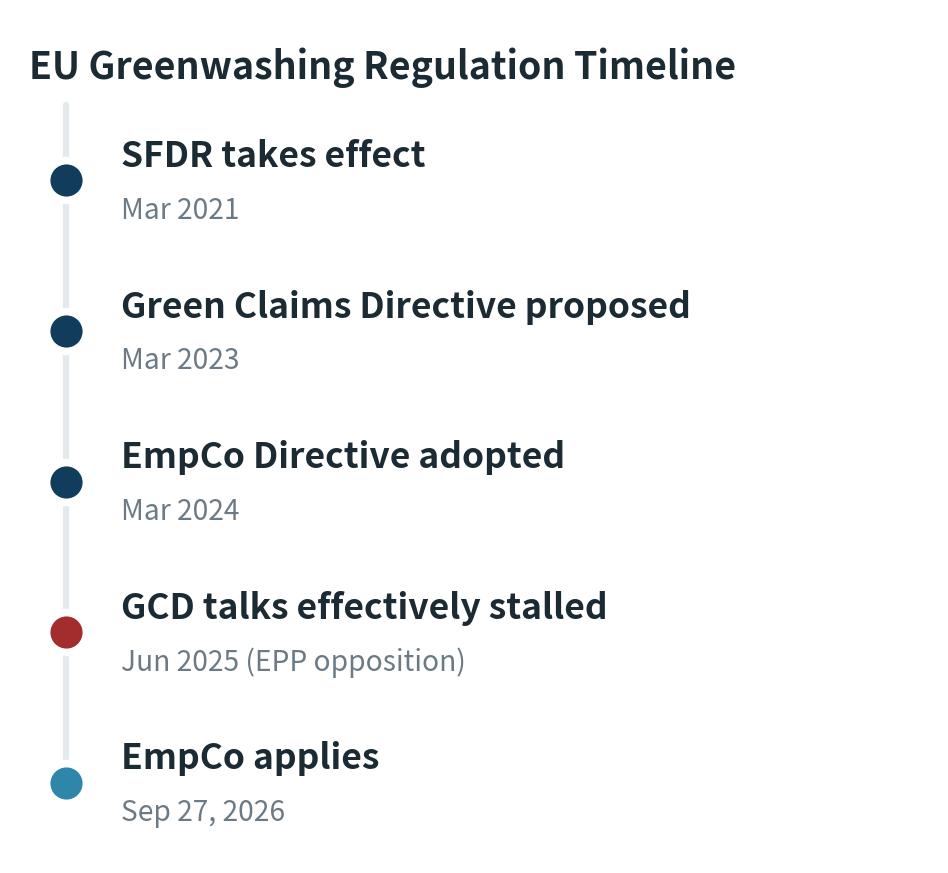
▲ The EU Green Claims Directive negotiations were suspended in 2025, while Directive (EU) 2024/825 will apply from September 2026.Source: European Union, Directive (EU) 2024/825
Source: European Commission, EU Directive 2024/825
Governments are making a range of efforts to regulate greenwashing, but it still takes time for new rules to move from proposal to enforcement.
That is why consumer scrutiny also matters. Asking companies to publish evidence can help turn broad promises into accountable practice. As consumers, we should pause when we see broad terms such as "eco-friendly," "green," or "natural," and look for the evidence behind them.
Three Questions to Ask Before Trusting a Green Claim
1. Where is the evidence?
Look for measurable data, an identifiable certifier, and a clearly defined scope.
2. Does the claim cover the whole impact?
Check whether one green feature is being highlighted while production, transport, use, or disposal is ignored.
3. What is the comparison?
Words such as "greener" or "lower impact" are meaningful only when the baseline is clear.
Written by Sharon Choi
Director of Planning, Sunhak Peace Prize Secretariat
References
1. World Economic Forum, How to spot greenwashing
2. TerraChoice, The Sins of Greenwashing
3. PwC, Voice of the Consumer Survey 2024