
―
The Fine That Comes with a Smile: The Quokka
―

▲ The quokka, which lives on Rottnest Island in Australia, may seem used to people, but it is still a wild animal in need of protection.Source: Instagram @cambojones2020
Does this face look familiar? With its chubby cheeks and ever-smiling expression, this little animal is the quokka, which lives on Rottnest Island in Australia. True to its nickname, “the happiest animal in the world,” just looking at a photo of it can lift your mood.
But the quokka has another nickname: “The fine that comes with a smile.” That is because the authorities in Western Australia have designated the quokka as a threatened species and placed it under special protection. The moment you touch this adorable face, you could receive a $300 fine.
According to the International Union for Conservation of Nature (IUCN), only about 7,500 to 15,000 quokkas remain in the world today. Does that sound like a lot? The problem is that the number continues to decline.
So who pushed this happy little animal to the edge? Unexpectedly, the culprit is us — humans. As people settled in Australia, they hunted quokkas, destroyed their habitats, and introduced invasive predators such as red foxes and cats, which prey on them.
Global warming has also played a role. As climate change has made Australia increasingly dry, a single major wildfire that swept through Western Australia in November 2015 killed 90% of the quokkas in that region. Ninety percent of a population lost in one wildfire — can you imagine how fragile that balance is?
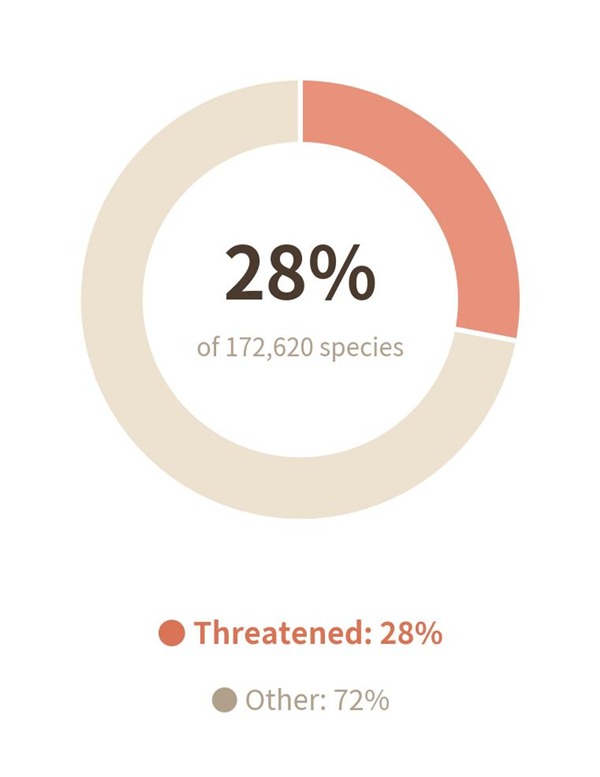
▲ This chart shows that many of the assessed species listed on the IUCN Red List are threatened with extinction.Source: IUCN Red List
But the quokka is, in fact, only one among countless victims. According to the IUCN Red List, more than 48,646 species besides the quokka are already threatened with extinction. That accounts for about 28% of the 172,620 species assessed so far.
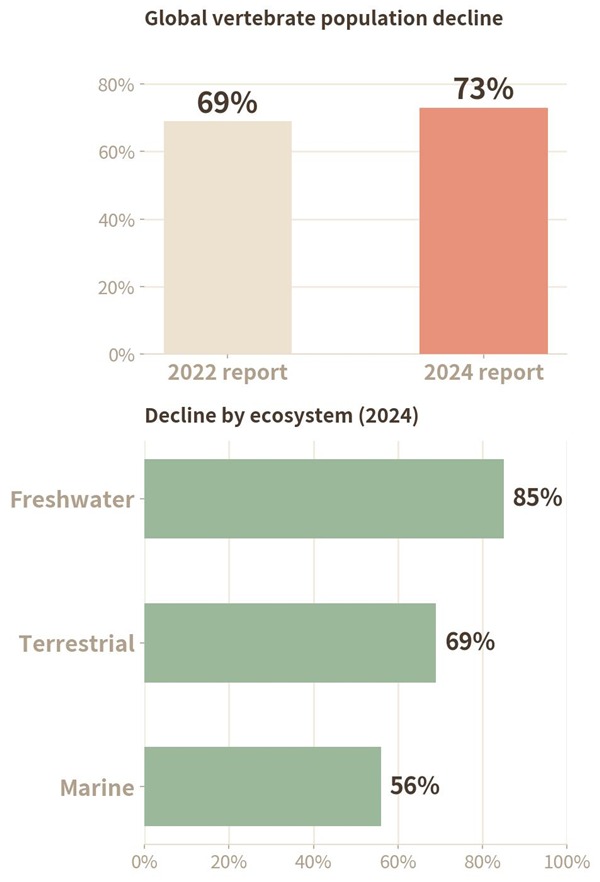
▲ The average size of monitored wild vertebrate populations worldwide declined by 73% between 1970 and 2020.Source: WWF, Living Planet Report 2024
Can you imagine more than one quarter of assessed species being at risk of disappearing? And if humanity depends on ecosystems to survive, can we truly remain safe after that?
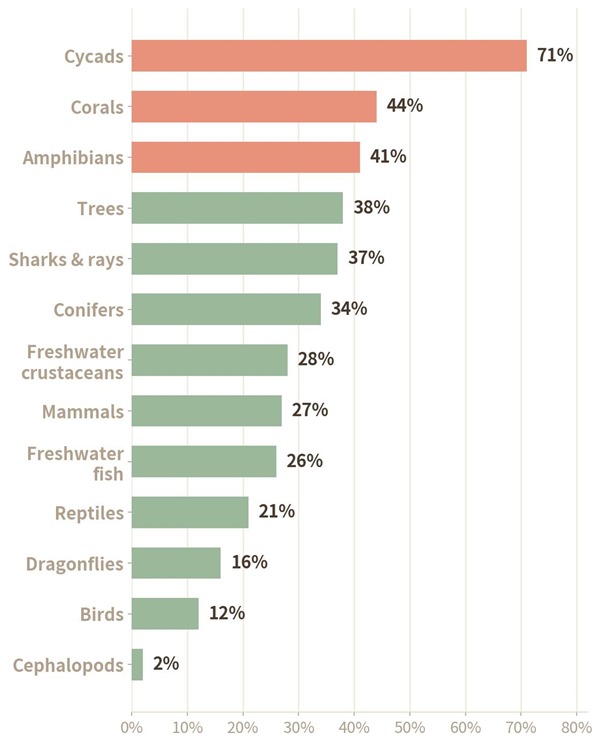
▲ This chart shows the proportion of groups at particularly high risk of extinction, such as cycads, corals, and amphibians.Source: IUCN Red List
―
Are We Next After the Dinosaurs?
The Sixth Mass Extinction Is Approaching
―

▲ Today’s biodiversity crisis is different from past mass extinctions because human activity is the central cause.Source: Sunhak Peace Prize
Can you believe that more than 99% of all species that have ever lived on Earth have already gone extinct? In fact, extinction itself is a natural process. What we should really worry about is not extinction, but mass extinction.

▲ This chart shows the five mass extinctions identified through the fossil record.Source: Sunhak Peace Prize
What the previous five mass extinctions had in common was a major change in Earth’s environment itself. Whether through volcanic eruptions or asteroid impacts, the planet became too hot or too cold for many forms of life to survive.
But the warming we face today is different. Because this time, it is not caused by nature. It is the result of human activity.
Since industrialization, the carbon dioxide emitted by humanity has steadily pushed up Earth’s temperature. According to the World Meteorological Organization (WMO), the years 2015 to 2025 were the 11 warmest years on record, and in 2025, the global average temperature was about 1.43 to 1.44°C higher than pre-industrial levels. Sea levels have already risen noticeably compared to 1901, and extreme weather events such as heatwaves, wildfires, and droughts are occurring more frequently and with greater intensity.
The result is the number we saw earlier: 28%. It means that more than one in four assessed species is now threatened with extinction.
To put it simply: Human-made warming → habitat destruction and climate disasters → mass disappearance of species. Whether we realize it or not, Earth is now standing at the beginning of the sixth mass extinction.
―
The Serial Killer of the Biosphere
―

▲ Human activity pressures biodiversity through habitat destruction, invasive species, pollution, excessive consumption, and overharvesting.Source: Sunhak Peace Prize
The American biologist Edward O. Wilson once called humanity a “serial killer of the biosphere” and a “monster on Earth.” It is a chilling expression. But if we look at one passage he left for future generations in his book The Future of Life, we can understand why he used such words.
“Together with the little unused wilderness we left behind, we bequeath to you lands that were once covered with forests. Your task will be to use genetic engineering to create new forms of life and adapt them to these ruins. Please accept our apologies, along with the record of the wondrous world that once existed.”
— Edward O. Wilson, The Future of Life
As the “monster” called humanity pushed out the habitats of other living beings and expanded its own territory, all life on Earth — including humans — has now been placed in danger. Wilson summarized the five ways humanity has destroyed nature using five letters: HIPPO.
HIPPO: The Threats to Biodiversity
H — Habitat Destruction
Destruction and degradation of habitats
I — Invasive Species
Introduction of invasive species
P — Pollution
Pollution
P — Population Pressure
Population growth and resource consumption
O — Overharvesting
Overfishing, excessive logging, and hunting
Wilson called our era the “bottleneck century.” A bottleneck is a situation where an entire system becomes blocked because of one single element. It is hard to find a more accurate description of the situation we face today: the entire web of life on Earth is being put at risk because of one species — humans.
―
Pay Attention to Biodiversity!
―
At the 1992 Rio Earth Summit, governments from 150 countries signed the Convention on Biological Diversity. The convention defines biodiversity as “the variability among living organisms,” including diversity within species, between species, and of ecosystems. That may sound complicated, but it can be understood more simply like this:
The Three Pillars of Biodiversity
1. Species Diversity
A state in which many different species exist within an ecosystem.
2. Genetic Diversity
A state in which different genetic traits exist even within the same species.
3. Ecosystem Diversity
A state in which different habitats exist, such as forests, wetlands, deserts, and oceans.
Biodiversity is the safety valve of ecosystems. It is the force that allows Earth to maintain balance on its own. In the end, “protection” means helping all living beings on Earth — from invisible microorganisms to humans — depend on one another and coexist. In other words, it is about respecting millions of species and the places they call home.
―
The Shadow Falling Across Our Tables
―

▲ Biodiversity loss directly affects food production, fisheries, and the cost of living.Source: Sunhak Peace Prize
Does biodiversity loss really affect our lives? It already does. And it begins somewhere very close to us: our tables.
Do you remember the “lettuce crisis,” when McDonald’s had to sell burgers without lettuce and Subway suspended sales of salad menus? It happened when a cold wave disrupted the lettuce supply.
Coffee prices are also becoming alarming. Poor coffee bean harvests in Brazil and Vietnam have pushed prices upward. One day, the simple pleasure of “a cup of coffee” may become a luxury. Crops sensitive to temperature, such as grapes, apples, and potatoes, are also struggling to grow properly in their traditional cultivation areas.
The ocean is no exception. Fishing activity has increased compared to 25 years ago, but wild fish catches have actually declined. One reason is that ocean dead zones — areas where pollution reduces oxygen levels in seawater — have increased by 75%.
―
From Biodiversity Loss to Recovery
―
1. Continuous and Integrated Research on Species Distribution and Habitats
2. Ongoing Protection of Rare and Endangered Species
3. Enacting and Enforcing Effective Laws to Protect Species
The international community has already made several commitments. Representative examples include the CITES Convention, which regulates international trade in endangered wild animals and plants, and the Ramsar Convention, which protects wetlands.
The Secretariat of the UN Convention on Biological Diversity publishes an official report every four years to assess the state of biodiversity. But the most recent report showed that among the targets set for 2010 to 2020, not a single one was fully achieved.
That is why scientists from the IPCC and IPBES launched a new initiative called “Bending the Curve.” It is a project that seeks ways to feed a growing global population while reversing the decline in biodiversity.
The conclusion was clear. Nature conservation efforts alone are not enough. Only when they are combined with sustainable production and consumption can we turn loss into recovery.
―
Social Distancing, and Distancing from Nature
―
To slow the spread of COVID-19, we practiced social distancing. Now, to slow the loss of biodiversity, it may be time to practice distancing from nature.
In fact, one of the root causes of COVID-19 is believed to be humanity’s expansion deep into wildlife habitats through development. The closer humans get to wild animals, the greater the chance of encountering new pathogens.
Ecologist Gerardo Ceballos of the National Autonomous University of Mexico warned in this spirit: “Protecting natural habitats is one of the most important preventive measures for reducing the risk of new infectious diseases.”
Protecting endangered species and habitats is important. But so is giving nature time to recover on its own — by reducing excessive intrusion and keeping an appropriate distance.
―
Shall We Become Spider-Man, Not the Villain of the Ecosystem?
―

▲ Biodiversity protection can begin not only with governments and businesses, but also with how we consume, move, and travel.Source: Sunhak Peace Prize
Earth is the only home shared by all living beings. But because of environmental destruction and global warming, this home is becoming an increasingly hot hothouse. What is even more heartbreaking is that living beings that did nothing to create this heat are facing extinction before humans do.
One of the most direct causes driving endangered species toward extinction is poaching. The northern white rhinoceros is a representative example. A groundless rumor that “rhino horn is a cure-all” pushed an entire species to the brink.
In the end, all of us living on the same planet are neighbors. By letting go of a little selfishness and refusing to exploit animals and plants, we can slow the loss of biodiversity.
Instead of becoming the worst villain in Earth’s history, what if we became friendly neighbors to Earth’s living beings — like Spider-Man?
Three Actions to Protect Biodiversity
1. Keep a Respectful Distance from Wildlife
Do not feed or touch wild animals, and do not damage their habitats.
2. Consume Responsibly
Avoid illegal wildlife products and overpackaged goods, and choose sustainable products.
3. Participate in Conservation Efforts
Take interest in local ecological surveys, citizen science, and habitat restoration activities.
Check endangered animals now: Go to the IUCN Red List
Written by Director Choi Yeon-je