
―
The Era of Bordered Intelligence Has Arrived
What is Sovereign AI?
―
At 11 PM, the corridors of an unnamed data center are filled not with people, but with the quiet breathing of servers. The low hum of cooling fans from thousands of GPUs; the green lights blinking between the server racks.
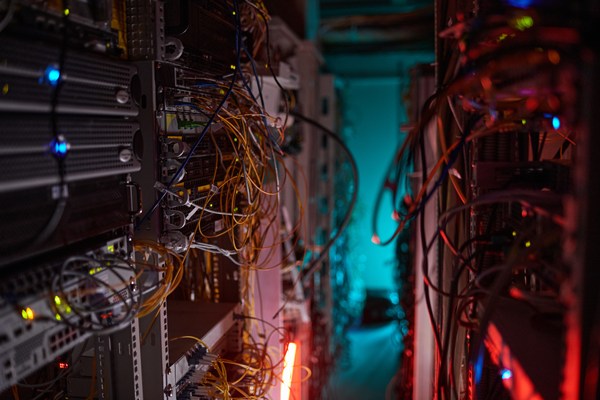
In that cool air, even at this very moment, someone's language, history, and habits are being converted into numbers. What these machines are processing are not mere electrical signals, but a nation's ability to 'think' for itself—intelligence itself.
Over the past two years, this scene has played out across the globe. In Denmark, a supercomputer was powered on in the presence of the King, while in Thailand, telecommunications and semiconductor companies joined forces to sign a cloud infrastructure contract. In Germany, true to its reputation as a manufacturing powerhouse, plans for an 'industrial AI cloud' were announced.
There were no dazzling spotlights or thunderous applause, but each and every one of those signatures marked a defining moment that will dictate the future of a nation.
What is Sovereign AI?
Have you ever heard the term 'Sovereign AI'?
The person who brought this phrase to the global stage is Nvidia's CEO, Jensen Huang. At the World Governments Summit held in Dubai, he made the following remark:
"Every country needs its own sovereign AI to produce intelligence rather than import it."
— Jensen Huang, CEO of Nvidia, World Governments Summit (2024)
First, let's take a closer look at the word 'sovereign'. It originally means 'possessing supreme power or authority'. The right of a nation to govern itself without foreign interference—what we call 'sovereignty' in politics—stems directly from this concept.
By attaching this word to AI, its meaning has expanded to imply that 'a nation must also possess sovereignty over its technology.'
The Sovereign AI he speaks of refers to a nation's ability to create and operate AI on its own, utilizing its native data, infrastructure, and workforce. Simply put, it is the act of building a 'brain that speaks your country's language' from scratch, using your own data.
It is a call to cultivate our own intelligence with our own hands, rather than entrusting the data that holds our language, culture, and history to foreign servers.
This concept rests upon three main pillars: [Sovereign AI]
Only when a nation holds these three elements firmly in its own hands, rather than relying on others, can the word 'sovereignty' truly be applied.
[Sovereign AI] A nation's ability to develop and operate independent AI models and services based on its own data, computing infrastructure, and talent. It goes hand in hand with 'data sovereignty' in that the data remains strictly under domestic control, rather than sitting on foreign servers.
―
The Sovereign AI Race: The World Dives In
AI Sovereignty Strategies of the US, China, France, and India
―
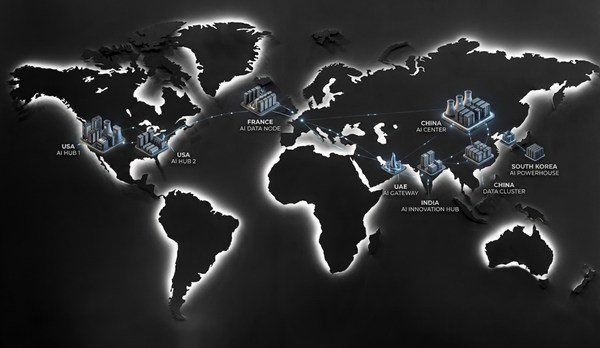
Even at this very moment, nations are sprinting to secure their 'intelligence sovereignty' in their own unique ways. Let's take a brief look at the moves being made by six different countries.
Strategic Moves in Sovereign AI by Country
▲ United States: Maintaining its position at the very front of the pack in this race.
▲ China: Forming the leading tier alongside the US, recently drawing significant attention with DeepSeek's low-cost, open-source strategy.
▲ France: Preparing what will be the highest-performing supercomputer in Europe.
▲ India: Building a large language model (LLM) based on its native language data; IBM CEO Arvind Krishna has also strongly urged the enhancement of the nation's AI capabilities.
▲ United Arab Emirates: Mobilizing sovereign wealth funds to invest billions of dollars into AI infrastructure.
▲ South Korea: Earnestly joining the fray with government budgets and the fierce competition to secure GPUs.
―
But Not Everyone Can Stand on the Starting Line of This Race
The Global AI Divide Leaving 118 Countries Behind
―
Here, we need to pause and ask a critical question. How many countries in the world can actually afford to power up a supercomputer and bet billions of dollars?
The truth is, not many. According to the United Nations Conference on Trade and Development (UNCTAD), 118 countries 'mostly developing nations' are completely left out of international AI governance discussions. Less than a third of developing countries have even established a national AI strategy.
The numbers from the Digital Progress and Trends Report published by the World Bank in November 2025 paint an even starker picture. High-income countries, comprising a mere 17% of the global population, account for 87% of major AI models, 86% of AI startups, and an overwhelming 91% of venture capital investments.
It is as if merely two out of ten people are scooping up the resources meant for eight or nine.
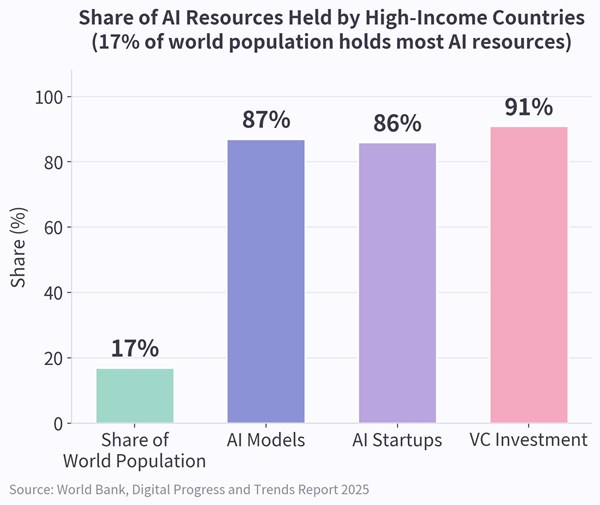
The Cost of AI Resources Claimed by High-Income Nations
▲ High-income countries, comprising just 17% of the global population, claim an overwhelming share of AI models, startups, and investments. / Source: World Bank, Digital Progress and Trends Report 2025
When we look at data center capacity, the gap widens even further. While high-income nations hold 77% of the global capacity, low-income nations possess less than 0.1%.
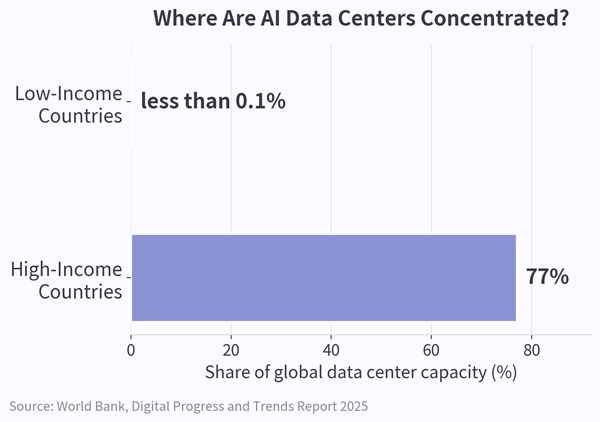
Where Are AI Data Centers Concentrated?
▲ While high-income nations hold 77% of global data center capacity, low-income nations possess less than 0.1%. / Source: World Bank, Digital Progress and Trends Report 2025
What these numbers tell us is starkly clear: the very ticket to join the Sovereign AI race is already a privilege reserved for a select few nations.
―
What the Divide Leaves Unsaid
The $4.8 Trillion AI Market and the Winner-Takes-All Structure
―
In its Technology and Innovation Report 2025, the United Nations Conference on Trade and Development (UNCTAD) projected that the global AI market will grow 25-fold over the next decade, reaching an estimated $4.8 trillion. It is a staggering level of growth.
But the real question lies elsewhere: whose pockets will this money actually go into?
The working paper The Global Impact of AI: Mind the Gap, published by the International Monetary Fund (IMF) in April 2025, offers something close to an answer. It argues that the gap in 'accessibility' to advanced hardware, data centers, and international partnerships will continue to widen the chasm between AI frontrunners and latecomers.
Indeed, the report estimates that the AI-driven growth effect in advanced economies could be more than double that of low-income countries.
The problem is not just the sheer size of the growth.
The IMF warns that this trend could solidify into a 'winner-takes-all' structure, concentrating market dominance in the hands of a few tech giants and a select few nations. The recent wave of semiconductor export controls and tightened scrutiny over foreign investments might very well be the reactions of countries that have preemptively sensed this shifting tide.
When we turn our attention to jobs, the picture becomes even clearer. At the 2024 World Economic Forum in Davos, IMF Managing Director Kristalina Georgieva warned that nearly 40% of global employment would be exposed to AI.
However, the 'color' of that impact varies by country. In high-income nations, 60% of jobs fall within AI's sphere of influence, but for a significant portion of them, this could actually serve as an opportunity to boost productivity.
In contrast, for countries with weaker safety nets, there is a high likelihood that this same shift will arrive not as an opportunity, but as a pure threat.
This disparity is already evident in the numbers. According to the report The Next Great Divergence, published by the United Nations Development Programme (UNDP) in December 2025, AI amassed 1.2 billion users within just three years of its emergence, with 70% of those users located in developing nations.
At first glance, this might seem like a hopeful statistic, but a closer look reveals a different story. While two out of three people are already using AI in some high-income countries, that ratio sits at a mere 5% in many low-income nations.
Philip Schellekens, UNDP Chief Economist for Asia and the Pacific, summed up this phenomenon in a single sentence:
"The central fault line in the AI era is capability."
— Philip Schellekens, UNDP Chief Economist for Asia and the Pacific
UN Secretary-General António Guterres echoed these exact concerns at the AI Action Summit in Paris in February 2025. He emphasized that the power of AI is currently concentrated in the hands of a few, and that this gap must be closed, rather than widened.
The Global AI Divide at a Glance
▲ Market Size: Projected to grow 25-fold to approximately $4.8 trillion within the next decade (UNCTAD)
▲ Governance Exclusion: 118 countries marginalized from international AI discussion tables (UNCTAD)
▲ Resource Concentration: High-income countries (17% of the population) claim 87% of AI models, 86% of startups, and 91% of investments (World Bank)
▲ Data Centers: High-income countries hold 77% vs. low-income countries at less than 0.1% (World Bank)
▲ Job Impact: Approximately 40% of global employment exposed to AI (IMF)
―
But Then, a Country Extended an Unexpected Hand
Kimi K3 and China's Global South AI Strategy
―
On July 16, 2026, Chinese AI startup Moonshot AI released a model named 'Kimi K3'. It boasted a staggering 2.8 trillion parameters, making it the largest open-source AI released to date. Within just a day of its release, it dethroned Anthropic's top-tier model on a coding leaderboard, claiming the number one spot—a first for a Chinese model.
And the very next day, during his opening speech at the World Artificial Intelligence Conference (WAIC) in Shanghai, President Xi Jinping stated:
"Seize this rare and historic opportunity to encourage open source."
At the same event, he also announced the launch of an AI cooperative initiative involving 29 countries.
Why 'open source', of all things?
For China—whose access to cutting-edge semiconductors has been choked off by U.S. export controls—it is far more advantageous to flip the script. Rather than competing in the arena of 'closed cutting-edge models' locked away by a handful of companies, they are shifting the battlefield to 'open models' that anyone can freely download and use.
The U.S.-China Economic and Security Review Commission (USCC) dubbed this the 'Two Loops' strategy in a March 2026 report.
It consists of one loop of innovation, continuously churning out open models, and another loop of deployment, embedding those models deeply across the manufacturing, logistics, and robotics industries. These two loops operate like interlocking gears.
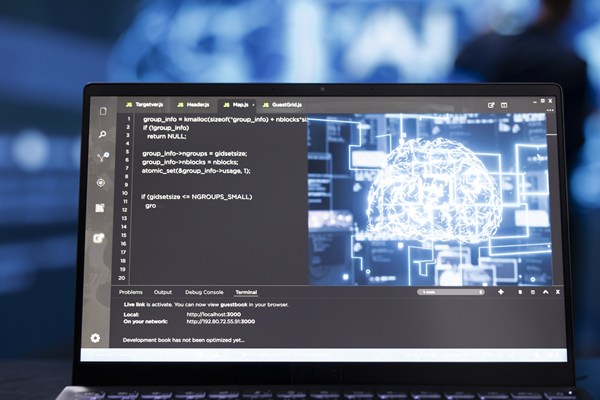
As of January 2026, Alibaba's open-source model, Qwen, had surpassed 1 billion cumulative downloads on Hugging Face. Export controls might be able to stop cutting-edge semiconductors from being loaded onto cargo ships, but they could never stop a developer in Nairobi, Jakarta, or São Paulo from downloading a single model file.
Indeed, in populous developing nations like Indonesia, these massive Chinese open-source models are emerging as quite an attractive option. An expert at a Malaysian AI consulting firm put it this way:
"We want the biggest models. But right now, the Western open-source camp just doesn't have them."
— Tze Jin Shee, Machine Learning Expert at Entermind AI, Malaysia
At first glance, this sounds like welcome news. Countries that lacked the resources to even get a foot in the door of this race can now lay their hands on state-of-the-art intelligence for free. It almost looks like a bridge spanning the divide we examined earlier.
But this raises a question.
Can a service built upon intelligence handed out for free by another nation truly be called 'our own intelligence'?
Perhaps we are merely trading our dependence on hardware for a dependence on source code and ecosystems. This is precisely where the profound weight of Sovereign AI strikes home once again.
―
Even in the Age of Intelligence, People Ultimately Come First
Cases of International Cooperation Bridging the AI Divide
―
What would you do? Is nurturing one's own national intelligence and reaching out to nations left behind truly a mutually exclusive choice?
As the DeepSeek case mentioned earlier demonstrates, openness and cooperation can actually serve as a shortcut for latecomers to narrow the gap. And the hopeful signals do not stop there.
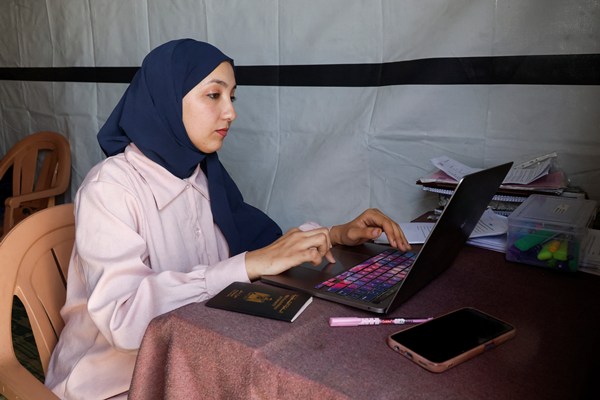
The UNDP report highlights AI tutors introduced in Bhutanese schools and an AI credit scoring system in Mongolia (which facilitated over $70 million in microloans to roughly 4,000 small businesses). These are real-world examples where AI has transformed lives, even in the absence of abundant resources.
Through the AI Skills Coalition, UNESCO is spearheading an initiative to train 10,000 participants, focusing primarily on developing countries and marginalized communities.
The World Bank report similarly points out that expensive, ultra-large models are not the only answer. Lightweight, affordable 'Small AI' is already driving tangible change on the ground in developing nations.
Ultimately, the finish line of the Sovereign AI race might not be defined by 'how many GPUs you possess.'
Whose language survives through that technology, whose voices are embedded within it, and whose next generation will reap its benefits. Perhaps the truer finish line lies in how earnestly we answer this very question.
(Source: Reuters)
Three Things We Can Do
1. Cultivating AI Literacy
Starting with a personal effort to understand exactly why Sovereign AI matters and where our own data is flowing.
2. Raising a Balanced Voice
Speaking up to urge international cooperation aimed at bridging the AI divide, recognizing that this is just as vital as the technological race itself.
3. Supporting the Next Generation's Learning
Showing a small but meaningful interest in supporting digital education programs at our local libraries and schools.
Let’s bring to mind once again the hum of the cooling fans that filled the space between the server racks. That sound will not belong to any single nation; ultimately, it will become the soundtrack of the next generation we will all share.
To prevent the world from fracturing into nations that possess intelligence and those that do not, every single question we ask today has the power to shift that trajectory, little by little.

Written by Sharon Choi
Director of Planning, Sunhak Peace Prize Secretariat
Further Readings
Reference
1. UNCTAD, "From divides to dialogue" — on the Technology and Innovation Report 2025
2. World Bank, Digital Progress and Trends Report 2025: Strengthening AI Foundations (2025.11.21)
3. UNDP, The Next Great Divergence: Why AI May Widen Inequality Between Countries (2025.12.02)
4. IMF, The Global Impact of AI: Mind the Gap, Working Paper No. 25/76 (2025.04)
5. CNBC / IMF, "IMF warns AI to hit almost 40% of jobs worldwide" (2024.01.15, Davos)
6. UN Secretary-General António Guterres, Remarks at the AI Action Summit, Paris (2025.02.11 report)
7. NVIDIA Blog, "Every Country Needs Sovereign AI" — World Governments Summit, Dubai
8. Bloomsbury Intelligence and Security Institute (BISI), Sovereign Artificial Intelligence
10. The Wire China, "Surrounding American AI from the South" (2026.6.21)
11. U.S.-China Economic and Security Review Commission, "Two Loops: How China's Open AI Strategy Reinforces Its Industrial Dominance" (2026.3, uscc.gov official)