
―
What Is Human Security?
―
Human security is not merely the absence of war, it is the right of every person to live in dignity, free from fear and want.
In this article, we will explore how invisible threats such as climate change, poverty, and inequality are shaking the foundations of our lives, and what we can do to protect them.
―
The Story of a 15-Year-Old Girl from Bangladesh
―
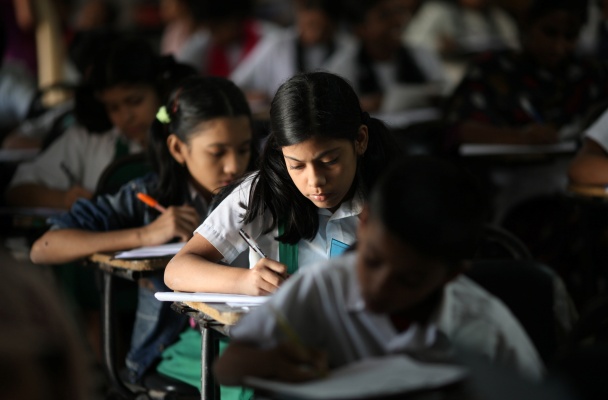
Banani, a 15-year-old girl from Bangladesh, can no longer sit in a classroom.
After a cyclone swept through her village, seawater flooded the farmland, and the soil became too salty to cultivate.
Her family’s livelihood collapsed, and Banani was forced to trade her schoolbag for a marriage proposal.
“Many of my friends have also gotten married or left to work for a living,”
she says.
A local teacher gives an even harsher account:
“In the past two years, 15–20% of students aged 14 to 18 have dropped out of school, and 60% of them are girls.”
There was no war, no gunfire
yet the climate disaster stole a young girl’s education and her future.
This is what an invisible war looks like a world where human security has collapsed.
―
What Is Human Security?
―
When we hear the word “security,” we often think of armies, guns, and borders.
But today’s real threats are not always visible.
Homes destroyed by climate disasters, invisible viruses, misinformation spreading with a single click, and people excluded from education and information because of the digital divide
these are the new battlefields of the 21st century.
Clean water, safe housing, trustworthy information, a society free from discrimination
each of these conditions essential for human dignity is, in truth, a matter of security.
That is why the concept of Human Security emerged
a new paradigm of protection centered not on the state, but on the individual.
While traditional security focuses on defending nations from external threats through military power,
human security focuses on safeguarding people’s lives, dignity, rights, and safety.
“Human security is about protecting human dignity, not defending with arms.”
— Mahbub ul Haq, founder of the Human Development concept
“Human security means protecting individuals from all forms of threats to life
violence, disease, hunger, disaster, inequality, and oppression
so that everyone can live in dignity and freedom.”
— UNDP, Human Development Report (1994)
―
The Seven Dimensions of Human Security
―
Human security is not an abstract idea.
It is tied to a very real, everyday question:
“Can I live safely today?”
The UNDP explains this concept through seven interconnected dimensions.
Let’s take a closer look at each one.
1. Economic Security
The right to work and earn a stable income without fear of hunger or eviction.
• Global extreme poverty: approximately 800 million people
• Jobs lost due to COVID-19: around 100 million
Source: World Bank, 2022
2. Food Security
The right of every person to access safe and sufficient food.
• People suffering from hunger: 830 million
Source: FAO
3. Health Security
The right to be protected from infectious diseases and to receive necessary medical care.
• COVID-19 vaccination rates:
High-income countries: 75% vs. Low-income countries: below 30%
Source: WHO
4. Environmental Security
The right to live safely amid climate change and natural disasters.
• 2022 Pakistan floods: 33 million people displaced
Source: UNHCR
5. Personal Security
The right to be protected from violence, abuse, and crime.
• About 33% of women have experienced sexual violence in their lifetime.
Source: UN Women
6. Community Security
A social environment that respects and protects cultural identity and minority rights.
• Examples: Persecution of minorities such as the Rohingya and Yazidis
(Monitored by Amnesty International and Human Rights Watch)
7. Political Security
The right to express opinions freely and to participate in politics without fear.
• Countries showing democratic decline (as of 2022): over 60 nations
Source: Freedom House
Each of these seven dimensions reminds us that true security means protecting human dignity in every aspect of life not through weapons or walls, but through justice, equality, and freedom.
―
Why Is Human Security So Urgently Needed Now?
―
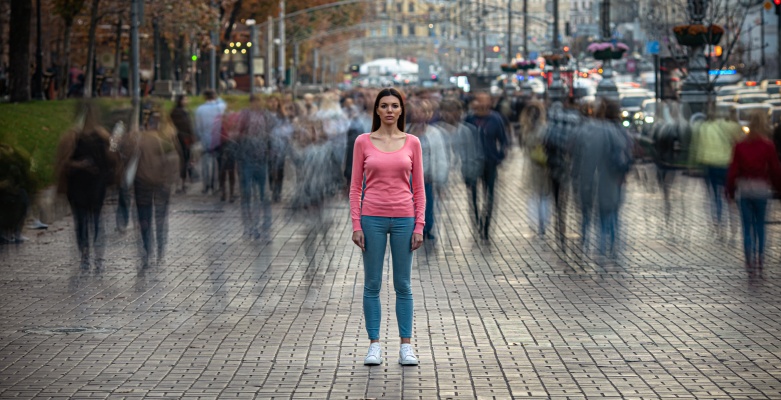
We are living in what could be called a “perfect storm of crises.”
War, climate disasters, pandemics, digital surveillance, misinformation…
The danger is not that these threats occur separately,
but that they intertwine and reinforce one another, shaking the very foundation of our lives.
The UNDP calls this new reality the “Human Security in the Anthropocene.”
If you’d like to learn more about the Anthropocene, check out the next article! ⇊ |
In its 2022 report, New Threats to Human Security in the Anthropocene,
the UNDP identifies five major emerging threats:
1. Climate Change
: More frequent floods, hotter summers, and climate disasters threatening livelihoods.
2. Health Risks
: Invisible viruses shaking the stability of life and safety.
3. Digital Divide
: Those disconnected from the internet are also disconnected from information and opportunity.
4. Mistrust & Polarization
: When trust collapses, the entire fabric of society begins to unravel.
5. Conflict & Violence
: Security is not only threatened by wars, but also by everyday violence and oppression.
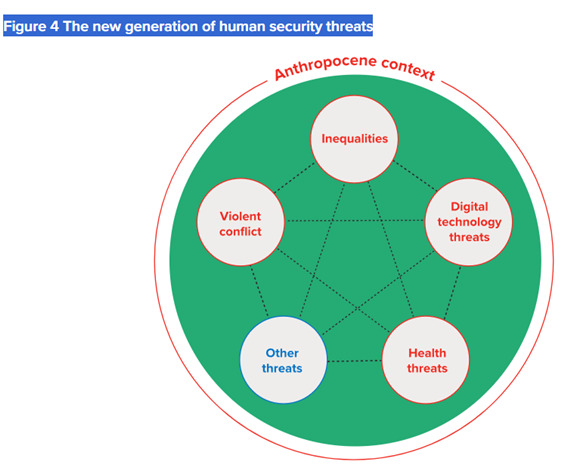
The Structure of New Human Security Threats in the Anthropocene
Source: UNDP 『2022 Special Report on Human Security』
―
The Current State of Human Security
―
The following figures show that human security is far from an abstract idea.
It is a matter of everyday survival.
• People displaced by climate disasters
: 33.9 million annually (Source: IDMC)
• People suffering from hunger
: Over 830 million (Source: FAO)
• Women who have experienced violence
: About 33% of all women worldwide
(Source: UN Women)
• Vaccination rates
: High-income countries 75% vs. Low-income countries below 30%
(Source: WHO)
• Internet access
: Developed countries 90% vs. Developing countries below 40%
(Source: ITU)
―
The Most Critical Human Security Issue
: Climate Change
―
Climate change is not merely about the weather.
According to scientists, in the worst-case scenario, if greenhouse gas emissions continue to rise at the current rate (RCP 8.5) the mortality rate caused by climate impacts could reach the level of deaths from cancer or heart disease by 2100.
In particular, Africa and the Middle East are projected to experience a sharp increase in deaths related to cardiovascular diseases and infectious illnesses.
Ultimately, responding to climate change is not just an environmental issue, but the most urgent human security challenge directly threatening our health and survival.
Q. What Is the Link Between Climate Change and Disease Mortality?
Researchers have modeled how disease-related deaths will vary depending on the amount of greenhouse gas emissions.
The results are shown in the graph below:
• Red bars: Worst-case scenario with high emissions (RCP 8.5)
• Blue bars: Moderate scenario with reduced emissions (RCP 4.5)
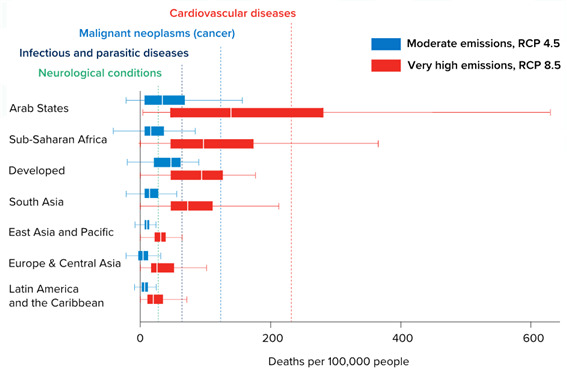
Predicted Disease Mortality by Region under Different Climate Scenarios
Source: UNDP 『2022 Special Report on Human Security』
Key Points to Note:
1. In Arab countries and Sub-Saharan Africa, the red bars rise steeply — indicating a sharp increase in mortality.
2. Even in developed countries, deaths from heart disease and cancer are projected to rise, though at a relatively smaller scale.
The key lesson is clear:
The impacts of the climate crisis are disproportionately severe in resource-limited countries and regions,
which means it is ultimately a global human security issue that affects everyone.
Therefore, climate action is a shared responsibility that requires the attention and participation of both nations and individuals.
If you’d like to learn more about the climate crisis, check out the next articles! ⇊ What are Countries Vulnerable to Climate Change? |
―
How Can We Protect Human Security?
―
The UNDP emphasizes that human security can no longer be defined solely as “protection.”
What truly matters is building a foundation where people have the power to act (Agency), the solidarity and trust that connect societies, and a balance between empowerment and protection.
• Agency : the ability to make choices and shape one’s own life.
• Solidarity : society grows stronger when people stand together.
• Empowerment : when people gain the strength to stand on their own, their lives begin to transform.
• Protection : a basic safety net is essential to reduce fear and uncertainty.
• Trust : the invisible foundation that sustains all the others.
In today’s world, the question of human security is no longer
“Am I safe?”
It is, instead, “Are we safe together?”
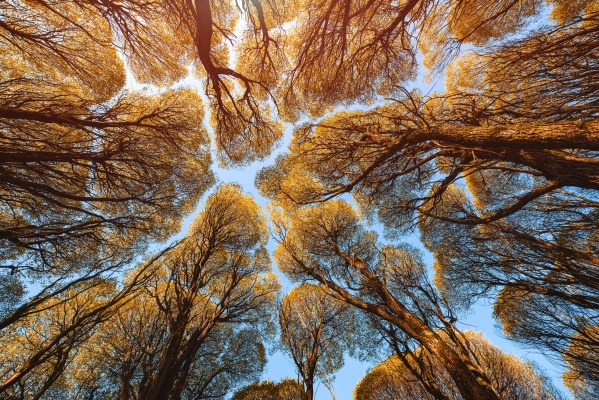
Just as trees in a forest are connected through their roots and can withstand the storm together, true human security in the Anthropocene era must be rooted in connection, trust, and collective resilience.
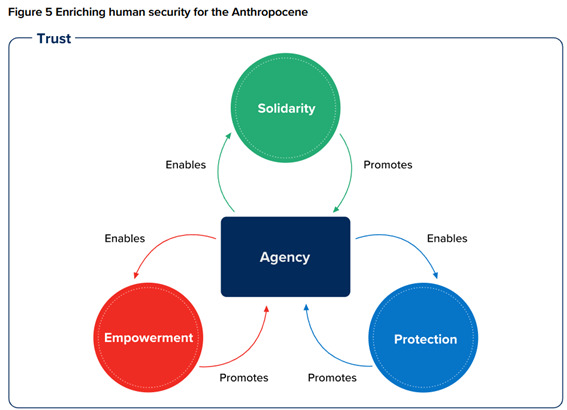
The Interconnected Framework of the Five Key Elements of Human Security in the Anthropocene
Source: UNDP 『2022 Special Report on Human Security』
―
Is There Anything I Can Do?
―
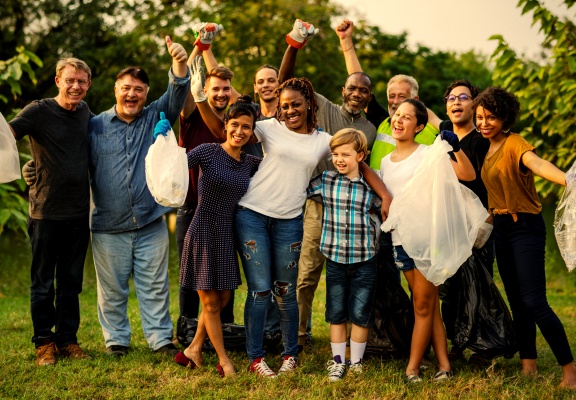
Of course there is.
Human security begins in our everyday lives.
When we choose to live in ways that protect one another’s safety and dignity,
the world becomes a little safer — and a little warmer.
1. Buy Fair Trade Products
• Why: Ethical consumption supports economic human security by rejecting child labor and exploitation.
• Where? fairtrade.net / Fair Trade Certified
2. Install Gender-Based Violence Alert Apps
• Why: Women and minorities face systemic threats to personal security.
• How: Use tools such as The Frontier Technologies Hub for real-time detection and reporting.
3. Donate Digital Devices & Support Digital Literacy Education
• Why: The digital divide threatens the right to access information.
• How: Participate through platforms like compudopt.org / Human-I-T.
4. Join Zero-Waste and Climate Citizen Campaigns
• Why: The climate crisis is the greatest threat to environmental security.
• Campaigns: 350.org, Climate Action Network (CAN)
5. Get Involved in Local Community Activities
• Why: Social isolation, aging populations, and local disasters are key challenges to community security.
• Examples: Youth civic participation, community gardening, volunteering or interning with social enterprises.
6. Practice Digital Activism on Social Media
• Why: A single hashtag or short video can spark global solidarity.
• How: Join movements like Global Citizen, TikTok Climate Campaigns, share #KeepItOn (against internet shutdowns), and spread human rights or environmental messages through Instagram Reels and memes.
―
Peace Begins with My Everyday Choices
―
The small choices you make today can become invisible forces protecting someone’s education, someone’s home, and someone’s life.
A cup of fair-trade coffee,
a single comment against hate online,
a reusable tumbler.
Every act that protects another’s safety is what ultimately makes your life meaningful.
Written by
Sharon Choi, Director
Recommended Reading: What are Countries Vulnerable to Climate Change? |
References: • United Nations Development Programme (UNDP). 2022 Special Report on Human Security. New York: UNDP, 2022. |